
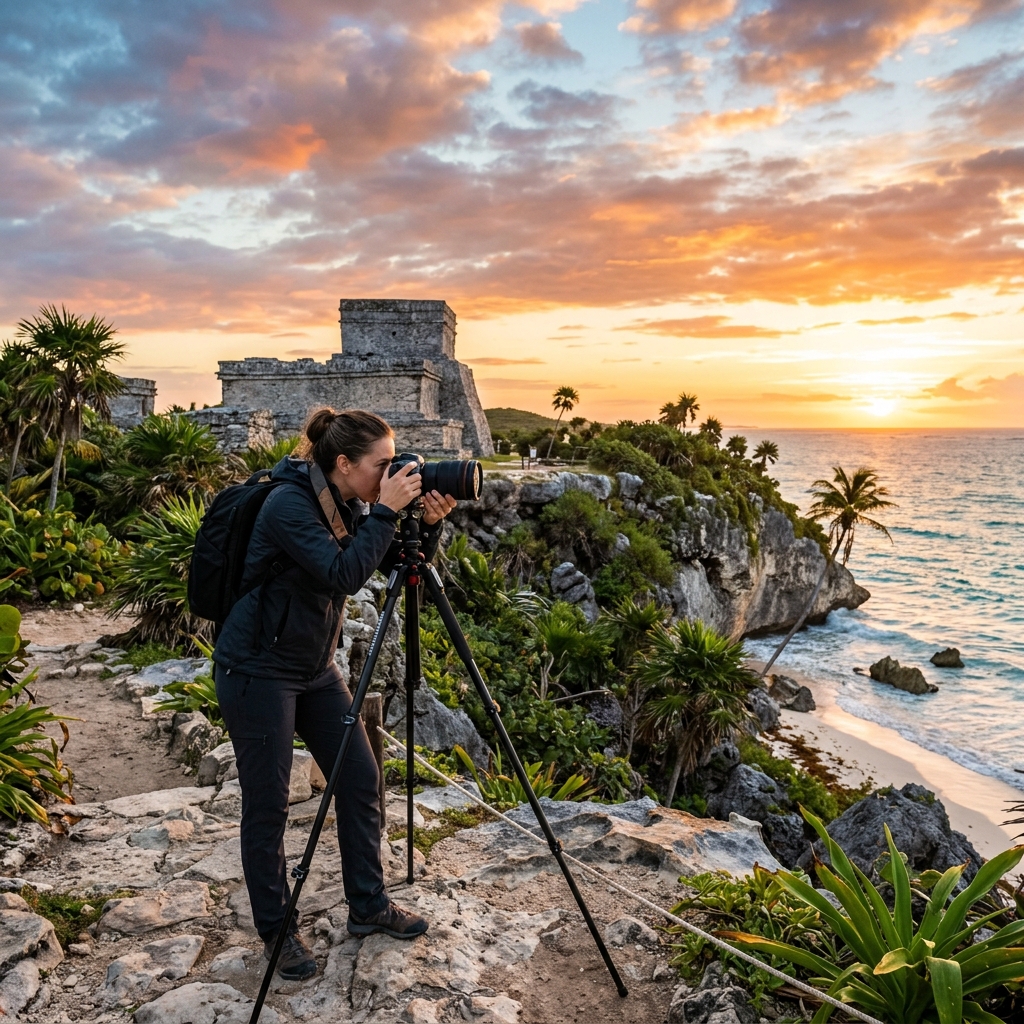
The Tulum ruins are one of the most photographed archaeological sites in the world — and also one of the most challenging to photograph in a way that feels original. Here's how to get images that reflect the actual drama of the site rather than the tourist-filled version most visitors capture.
The light
The Tulum ruins face east, toward the Caribbean. This means morning light (8–10am) hits the front faces of El Castillo and the Temple of the Frescoes directly — warm, golden, and dramatically different from the flat midday light that most visitors experience. The site opens at 8am. The first hour of opening provides the best photographic light and the lowest crowd levels simultaneously. This is not a coincidence you can replicate at 11am — it's a window that closes.
Late afternoon (4–5pm) creates a different quality of light from the west, which illuminates the sides and backs of the cliff structures in warm tones. The site closes at 5pm — the last 30 minutes of the day have noticeably fewer visitors than midday.
The compositional challenge
All the main structures at Tulum are roped off — you cannot get closer than approximately 5–10 meters to El Castillo. This means telephoto is helpful rather than wide angle for the main pyramid. A 50–200mm equivalent range is more useful than an ultra-wide.
The iconic Tulum shot (El Castillo above the turquoise Caribbean) requires positioning on the path that approaches the cliff edge from the inland side of El Castillo. This shot is possible without a telephoto — the entire structure fits in frame from approximately 30 meters at standard focal length.
The beach below
Access to the beach below the ruins (via stairs inside the archaeological zone) is the best compositional opportunity at Tulum — the cliff face with El Castillo above and the turquoise water is the most dynamic angle at the site. Morning light reaches this beach from above the cliff to the east, creating rim lighting on the structure. This angle requires being at the beach between 8–10am for the best light.
Avoiding people in your shots
Patience and timing. At 8am, 60-second gaps between tourists at the main structures are possible. At 10am, they're not. The most effective technique at busy times: use the rope lines as compositional foreground elements that frame the structures — they're permanent features and incorporating them rather than fighting them produces more honest images of the site.
Gear recommendations
Wide-angle to short telephoto (24–135mm equivalent) covers everything useful at the site. A polarizing filter is genuinely useful for the Caribbean water — it eliminates surface reflection and deepens the turquoise color visible in the water below the cliff. Avoid drones: they're prohibited at all Mexican archaeological sites and the regulations are enforced.
