
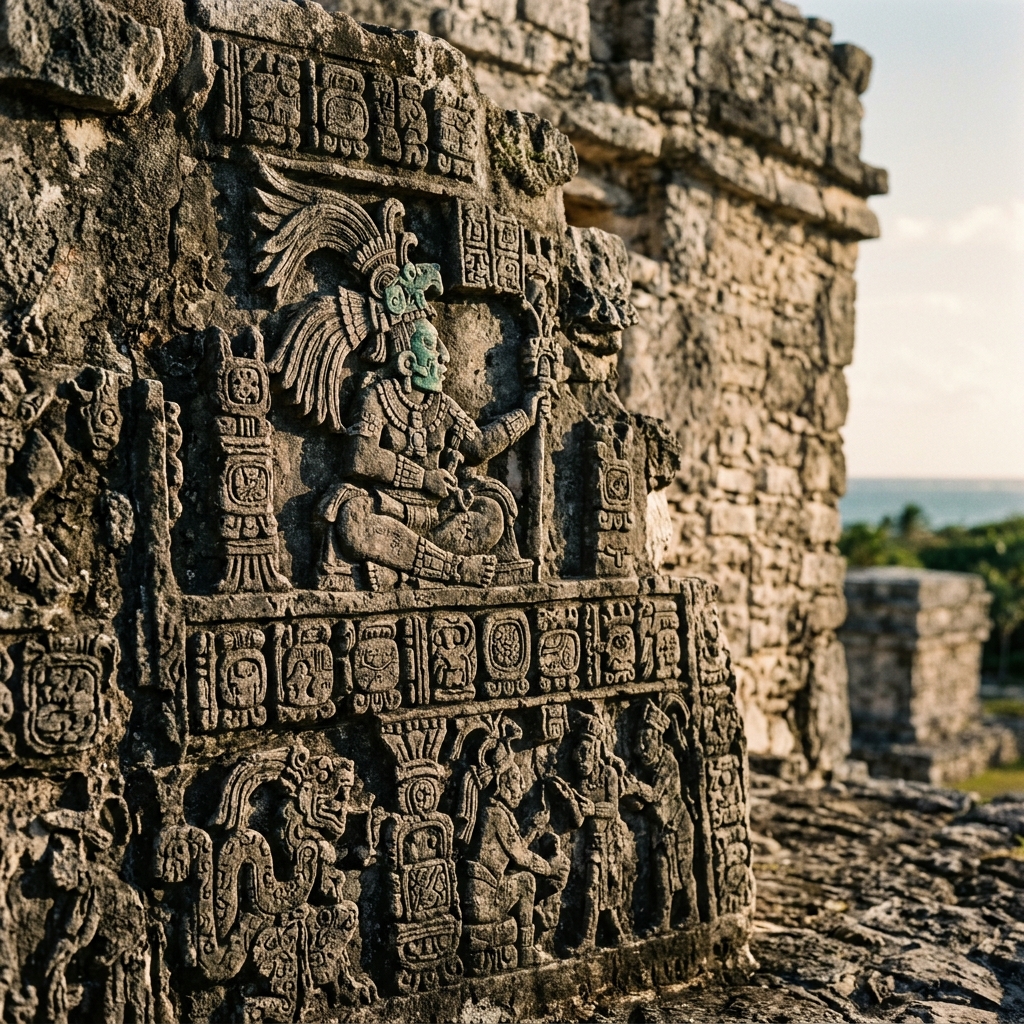
Most visitors to the Tulum ruins see the site as a collection of photogenic structures on a cliff. The ruins make significantly more sense — and the visit is more rewarding — with basic context about what the Maya civilization was, when it existed, and what Tulum specifically was used for. Here's the history that the site itself doesn't adequately explain.
The Maya civilization — a brief orientation
The Maya are not a single ancient culture but a continuous civilization that has existed in Mesoamerica for at least 3,000 years and whose descendants — approximately 7 million Maya people across Mexico, Guatemala, Belize, Honduras, and El Salvador — are alive today. "The Maya" in the conventional sense refers to the peak Classic period (250–900 CE), when major cities like Tikal, Palenque, and Chichén Itzá (in its earlier form) represented the apex of Maya political and cultural achievement.
Tulum belongs to the Post-Classic period (900–1520 CE) — after the collapse of the major Classic centers. Post-Classic Maya civilization reorganized around coastal trade networks and smaller political entities rather than the large inland kingdoms of the Classic period. This context explains why Tulum looks different from the grand sites: it was built for a different purpose in a different political era.
What Tulum was
Tulum (originally called Zama, meaning "dawn" in Yucatec Maya, for its east-facing cliff) was a walled trading port. The Caribbean coast trade network that connected Tulum with Cozumel, the Gulf of Mexico, Honduras, and points beyond was one of the most extensive in pre-Columbian America. The goods traded included jade, obsidian, copper bells, cacao, textiles, and slaves. El Castillo served as a lighthouse — its windows are positioned to create light effects that mark the only safe passage through the reef directly below the cliff, guiding trading canoes.
The murals
The painted murals inside the Temple of the Frescoes (partially visible through the barred windows) are among the best-preserved examples of Post-Classic Maya painting. They depict the Maya rain deity Chaac, Ixchel (the moon goddess associated with medicine and weaving), and scenes from the Maya cosmological cycle. The pigments — made from ground minerals mixed with plant-based binders — have survived 600 years of Caribbean humidity. The blue-green color distinctive in Maya painting is "Maya Blue," a pigment made from indigo and the mineral palygorskite, which is chemically stable in a way that most organic pigments are not.
The Spanish contact
Tulum was one of the first Maya cities seen by Spanish explorers. Juan de Grijalva's 1518 expedition recorded seeing "a city as large as Seville" from the sea — almost certainly Tulum. The Spanish noted the white-plastered walls and the ceremonial fire maintained on El Castillo as a lighthouse guide. The city was abandoned within 70 years of Spanish contact, probably due to the epidemics (smallpox, measles) that killed an estimated 90% of the indigenous population of the Americas in the 16th century.
