
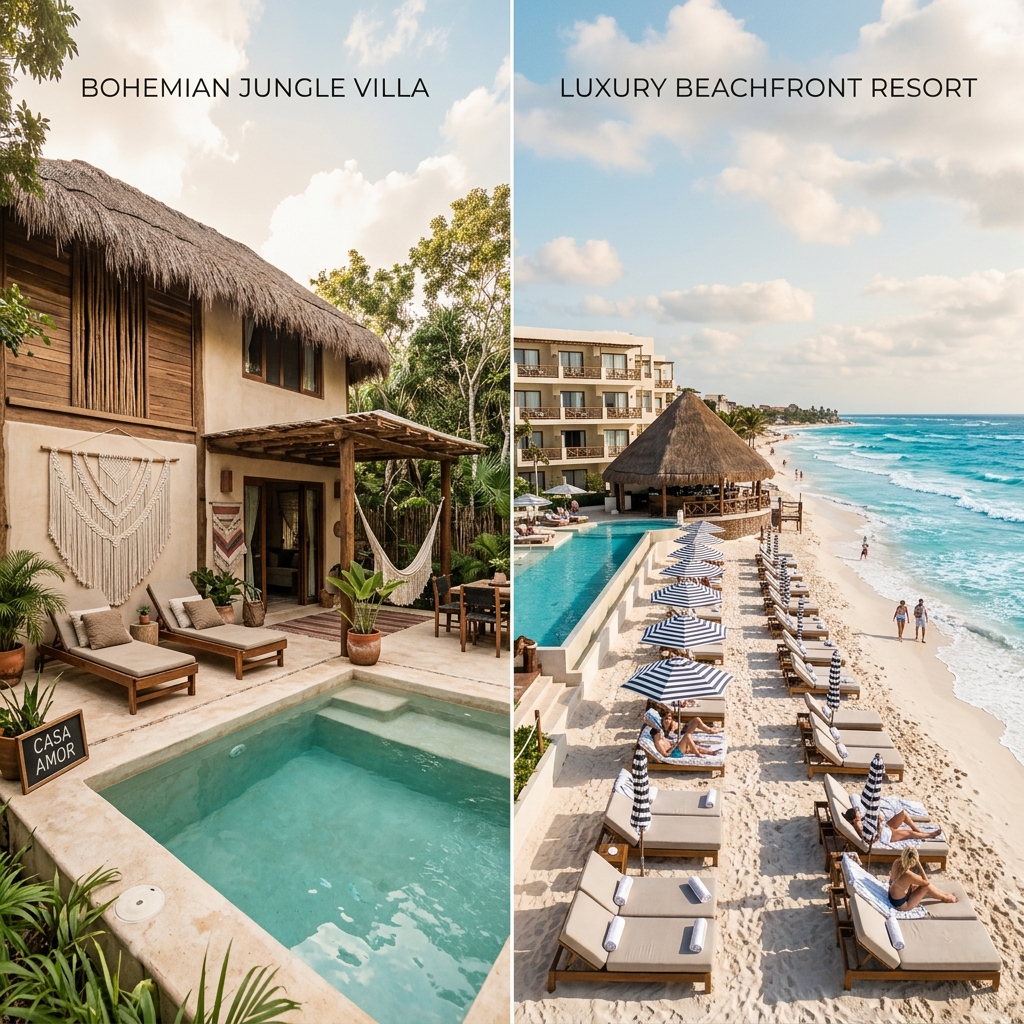
Tulum has one of the most active short-term rental markets in Mexico — the combination of a tourism economy, a large expat community with investment properties, and visitors who prefer apartment living has created a robust Airbnb and VRBO market. Whether this is better or worse than a hotel depends significantly on your stay length, group size, and what you want from accommodation.
Airbnb in Tulum — what's available
Short-term rentals in Tulum fall into three categories: Hotel zone casitas and bungalows (individual units within larger properties, sometimes with shared pool access), Aldea Zamá apartments and villas (the most developed private rental market), and Pueblo apartments (genuinely local neighborhood accommodation at local prices). The range runs from $60 USD per night for a Pueblo studio to $800+ USD per night for a hotel zone jungle villa with private cenote access.
When Airbnb wins
Groups of 3+ people: A 3-bedroom house in Aldea Zamá at $250 USD per night splits to $83 per person — roughly the equivalent of budget hotel accommodation, but with private kitchen, living space, and garden. For groups, the cost-per-person math almost always favors a rental over individual hotel rooms.
Stays of 5+ days: The weekly discount (typically 10–20%) and the value of kitchen access (enabling one or two self-catered meals per day) makes Airbnb increasingly competitive for longer stays. Grocery shopping at the Pueblo market versus eating every meal at restaurants saves $500–1,000 MXN per day per person.
Digital nomads: Private rentals almost always offer better WiFi, more desk space, and quieter work environments than hotels. The ability to establish a routine — coffee at home, work at the desk, cooking some meals — is more sustainable for a working stay than hotel service dependency.
When hotels win
Short stays (1–3 nights): The cleaning fees on Airbnb (often $50–100 USD) make short stays poor value relative to hotels. A $150 USD hotel room for one night beats a $100 USD Airbnb plus $80 USD cleaning fee.
First visit: Hotels provide local knowledge, concierge service for restaurant reservations and transport, and a safety net for first-time Tulum visitors who don't know the area. This value is real and decreases with subsequent visits.
Beach access priority: Hotel zone hotels offer beach access that private rentals rarely replicate. A rental 500 meters from the beach is 500 meters — hotel guests wake up in the hotel zone and walk 30 seconds to the sand.
Practical Airbnb advice for Tulum
Verify WiFi speed specifically (not just "WiFi available") — ask hosts for a screenshot of their speed test before booking if reliable internet matters. Check the distance to the beach precisely, not approximately — "5 minutes to beach" can mean 5 minutes by car, which is meaningless without a car. Read reviews specifically for mentions of mosquito issues (more significant at jungle-adjacent properties), noise (beach road properties can have nightclub noise from adjacent venues), and water pressure (variable at older properties).
