
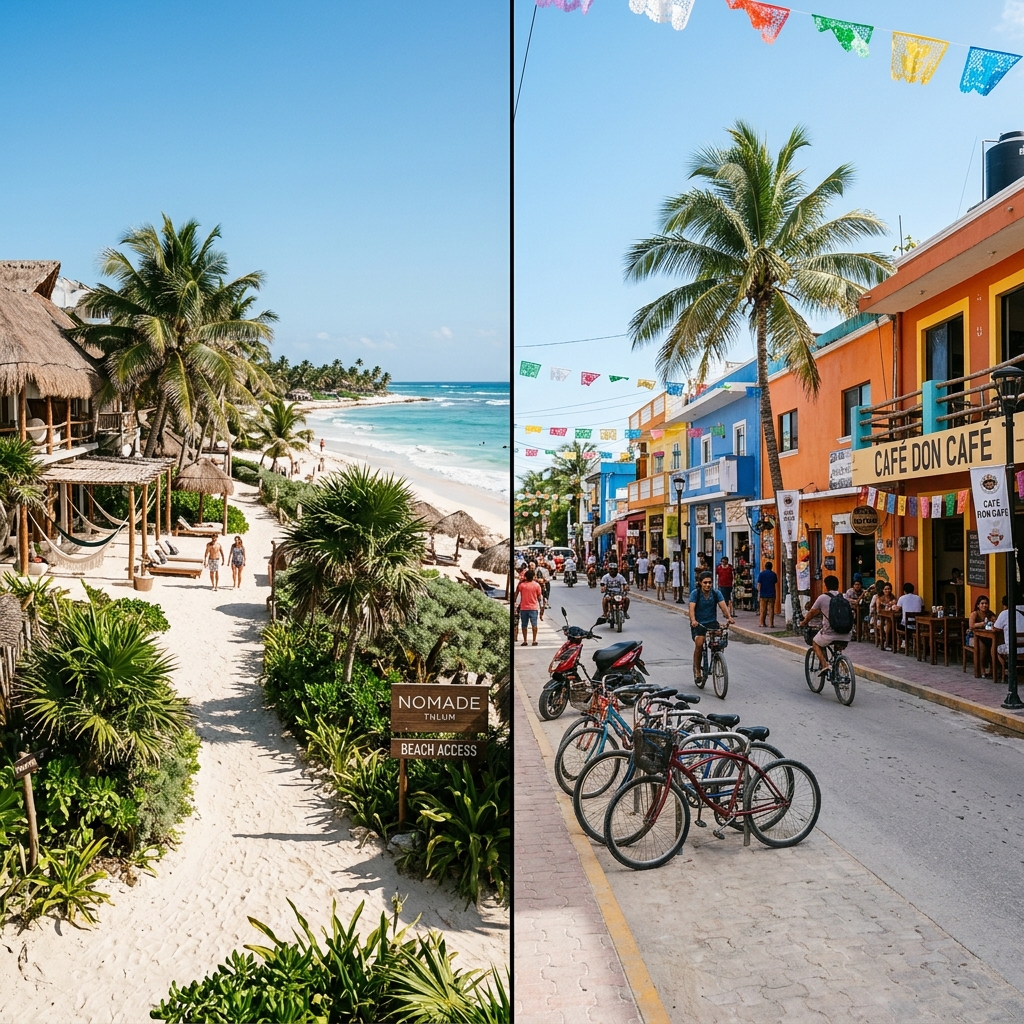
The hotel zone vs. Pueblo question is the most important decision for Tulum visitors and the one most travel guides handle inadequately. Here's the honest comparison with enough specificity to make the right choice for your situation.
Hotel zone — the case for it
Beach access: Wake up, walk 30 seconds, swim in the Caribbean. If daily beach access is the core of your Tulum trip, the hotel zone is the only way to make this effortless. Taxi rides from Pueblo to the beach cost $100–150 MXN each way, add up to $400–600 MXN per day if you're making multiple trips, and require logistics that interrupt the relaxed flow a beach vacation is supposed to provide.
The environment itself: The Tulum hotel zone eco-hotels are genuinely beautiful — the thatched architecture, the jungle setting, the cenote access at some properties. Staying here puts you inside the Tulum aesthetic rather than adjacent to it.
Nightlife access: Walking distance to Papaya Playa Project, Gitano, Zamna, and most of the venues worth visiting. Coming home from a jungle party by foot or bicycle is a significantly better experience than organizing a midnight taxi.
Hotel zone — the case against it
Price: The cheapest reasonable hotel zone accommodation starts at $200 USD per night in low season. During high season (December–March), the same room costs $400–700 USD. A week in the hotel zone at mid-range quality: $1,400–5,000 USD for accommodation alone, before food, drinks, and activities.
Practical inconveniences: Unreliable electricity, limited WiFi, mosquitoes more present than in Pueblo, restaurant options requiring transport, and an unpaved road that becomes difficult in rain.
Isolation from real Tulum: The hotel zone is a self-contained tourist ecosystem. If you want to experience the actual life of Tulum — the Pueblo market, the local restaurants, the working community — you need transportation from the hotel zone.
Tulum Pueblo — the case for it
Price: $40–180 USD per night covers good accommodation in Pueblo. The same $200 USD budget buys significantly more comfort and space in Pueblo than in the hotel zone.
Infrastructure: Reliable WiFi, air conditioning, hot water, restaurants within walking distance, and the full range of Tulum Pueblo's food and social scene immediately accessible.
Authenticity: Tulum Pueblo is a functioning Mexican town. The daily life visible from any Pueblo hotel — market vendors, school children, local businesses — is the actual Tulum that the hotel zone aesthetic was originally inspired by.
Tulum Pueblo — the case against it
The beach is not walkable. Organizing daily beach access requires either renting a bicycle ($100–150 MXN per day) or paying for taxis ($100–150 MXN each way). Over a week, this adds $500–1,500 MXN in transport that partially offsets the accommodation savings. If beach access is the primary reason you're in Tulum, Pueblo requires more management than the hotel zone.
